
The Developmental Benefits of Art Classes for Young Children in Beaverton and Portland
When parents start searching for kids art classes in Beaverton or Portland, they are usually looking for more than just something to fill time after school.
They are looking for confidence. They are looking for social connection. They are trying to reduce screen time. And they are right to be thinking about all of that.
After 20 years in the classroom and now running Whimsy Wees Art Studio, I have seen firsthand that the developmental benefits of art classes for young children go far beyond what most people expect.
Art is not just a creative outlet. It is one of the most powerful tools for child development, and it is often the one kids are getting the least of.
Art Builds Confidence Through Process, Not Perfection
One of the biggest misconceptions parents have is that confidence comes from making something that looks good. It does not. Confidence comes from the experience of creating.
In many traditional settings, kids are given a sample and expected to recreate it. The moment that happens, comparison begins.
In our kids art classes, we intentionally avoid that. Instead, we introduce artists and ask,
“What do you notice?” Kids almost always identify the most important elements on their own. Then we show them how to use the materials properly and let them take it from there.
Almost every child asks at some point, “Do I have to do it like that?” And the answer is always NO. That moment is where confidence starts to grow.
Art Classes Help Kids Build Social Skills Naturally
Many parents enroll their child in art classes for kids hoping it will help with social skills.
What makes art different is that connection happens naturally. Kids sit side by side. They notice each other’s work. They become curious. Conversations start without pressure.
At the end of class, we bring everyone together for an art circle. Kids share their work, give compliments, and learn how to talk about what they created.
For many children, especially those who struggle in structured environments, this is the first time they feel comfortable expressing themselves.
Art Is a Powerful Alternative to Screen Time
One of the biggest reasons parents search for creative activities for kids near them is to balance out screen time. And the difference is noticeable.
Kids who spend a lot of time on screens often wait for instructions. They are used to being entertained. They can struggle with open ended tasks.
Art asks something completely different of them.
It asks them to take initiative.
It asks them to make decisions.
It asks them to problem solve.
It asks them to try again when something does not work.
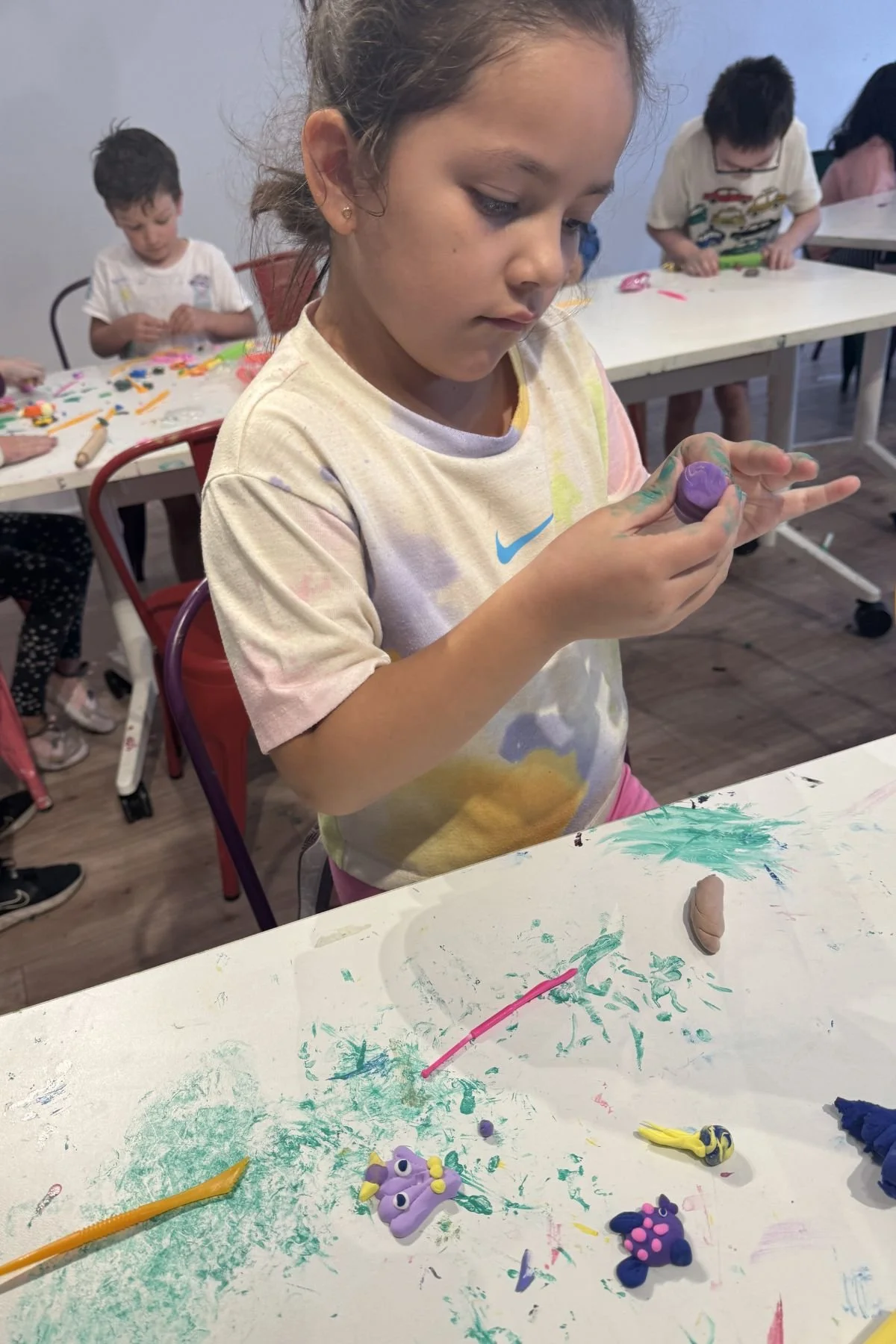
Even something as simple as working with clay reveals this. Some kids are immediately drawn to the sensory experience, while others feel frustrated when their idea does not turn out as expected. That moment is where real growth happens.
When young children feel that frustration, we gently guide them through it. We ask, “What part is feeling tricky?” Then we model that specific step and support them as they try again, building both confidence and resilience in the process. This kind of hands-on, supported learning is exactly what we create in our summer art camps at Whimsy Wees Art Studio, where kids have the time and space to explore, problem solve, and grow through the process.
The Hidden Developmental Skills Kids Gain From Art
When parents sign up for kids art classes in Beaverton, some often expect their child to come home with a painting or project that can be framed. What they don’t always see are the deeper developmental skills being built.
In every class, kids are strengthening fine motor skills as they learn how to control brushes, tools, and materials. They are developing problem solving skills as they figure out how to bring their ideas to life. They are building resilience when something does not go as planned.
They are growing independence, especially during open studio time when they choose what to create without step by step instructions. They are practicing communication through art circle, learning how to give and receive feedback. And most importantly, they are developing creativity in a meaningful way. Not just making something fun, but learning how to think, adapt, and create from their own ideas.
Why Art Education Is Missing and Why It Matters
In many local districts like Beaverton and Portland, art is no longer a consistent part of the school day. What often replaces it is a limited version of art tied to history lessons, like Art Lit. This is a PTO funded program where kids learn about an artist and then try to recreate a specific sample project in a short amount of time. Because there a specific sample, there is usually a right way to do the project, limited flexibility with the materials and rarely enough time.
For many children, this can actually discourage creativity. If their work does not match the sample, they feel like they have done something wrong. The reality is that teachers are doing their best. There are simply not enough hours in the day, and academic requirements take priority.
When Art Disappears in the Classroom, Something Important Goes With It.
Younger children are naturally creative. In fact, one of the most well-known studies on creativity, originally developed by NASA scientist George Land in 1968, found something incredible.
Researchers tested 1,600 children between the ages of 4 and 5 using a creativity test designed to measure imaginative thinking. The results showed that 98 percent of those children scored at what was considered “genius level” creativity.
But what is even more telling is what happened next.
The same children were tested again as they grew older. By age 10, only 30 percent still scored at that level. By age 15, it dropped to 12 percent. And in adulthood, just 2 percent remained at that “genius” level of creativity.
That is not because children lose creativity naturally. The researchers concluded that something in the way we educate and structure learning actually teaches kids to think inside the box rather than outside of it. And I see that play out in real time.
Young children come into the studio full of ideas. They are bold. They take risks. They create without hesitation. But as they get older, many begin to second guess themselves. They look for the “right answer.” They hesitate before they begin. Some even stop creating altogether.
That is why having a space where kids can explore, experiment, and create freely is not just nice to have. It is essential. Because creativity is not something kids need to learn.
It is something they need to hold onto.
Why Finding the Right Art Class Matters
For families looking for art classes for kids in Beaverton or Portland, the environment matters just as much as the activity itself. Kids need a space where they can explore materials, try new ideas, and create without pressure. That is exactly what you will find in our kids art classes at Whimsy Wees Art Studio, where creativity is encouraged and every child’s ideas are valued.
They need guidance without strict rules.
They need encouragement without comparison.
They need the freedom to make something that is entirely their own.
Because the goal is not to raise professional artists. It is to raise confident, capable, creative humans. And sometimes that starts with a paintbrush, a piece of clay, and the simple idea that they can do it their way.
